PostTime:8/27/2026
Recently, the Office of Science and Technology Commission of the CPC Guangdong Provincial Committee released its second batch of typical cases on provincial science and technology system reform. Among the selected entries, Guangdong Technion – Israel Institute of Technology (GTIIT) stood out with its innovative "four-dimensional linkage" mechanism—integrating research, teaching, industry, and talent—to address the bottleneck in chemical engineering software through deep industry-education integration. The case was included under the category of "Coordinated Reform of Education, Science, and Talent Systems," offering a replicable model for universities across the province.
For years, China's chemical industry has been caught in a double bind: core industrial software dominated by foreign commercial products, and a structural mismatch between talent supply and industry demand. To break down the institutional barriers separating education, research, and industry, GTIIT Assoc. Prof. Xi Gao's team pioneered a reform pathway centered on four interconnected pillars: research breakthroughs, teaching redesign, industrial application, and talent giveback. This approach turns critical national priorities into teachable content in the classroom, replicable work in the lab, and deployable tools in the industry, truly aligning academia with industrial needs.
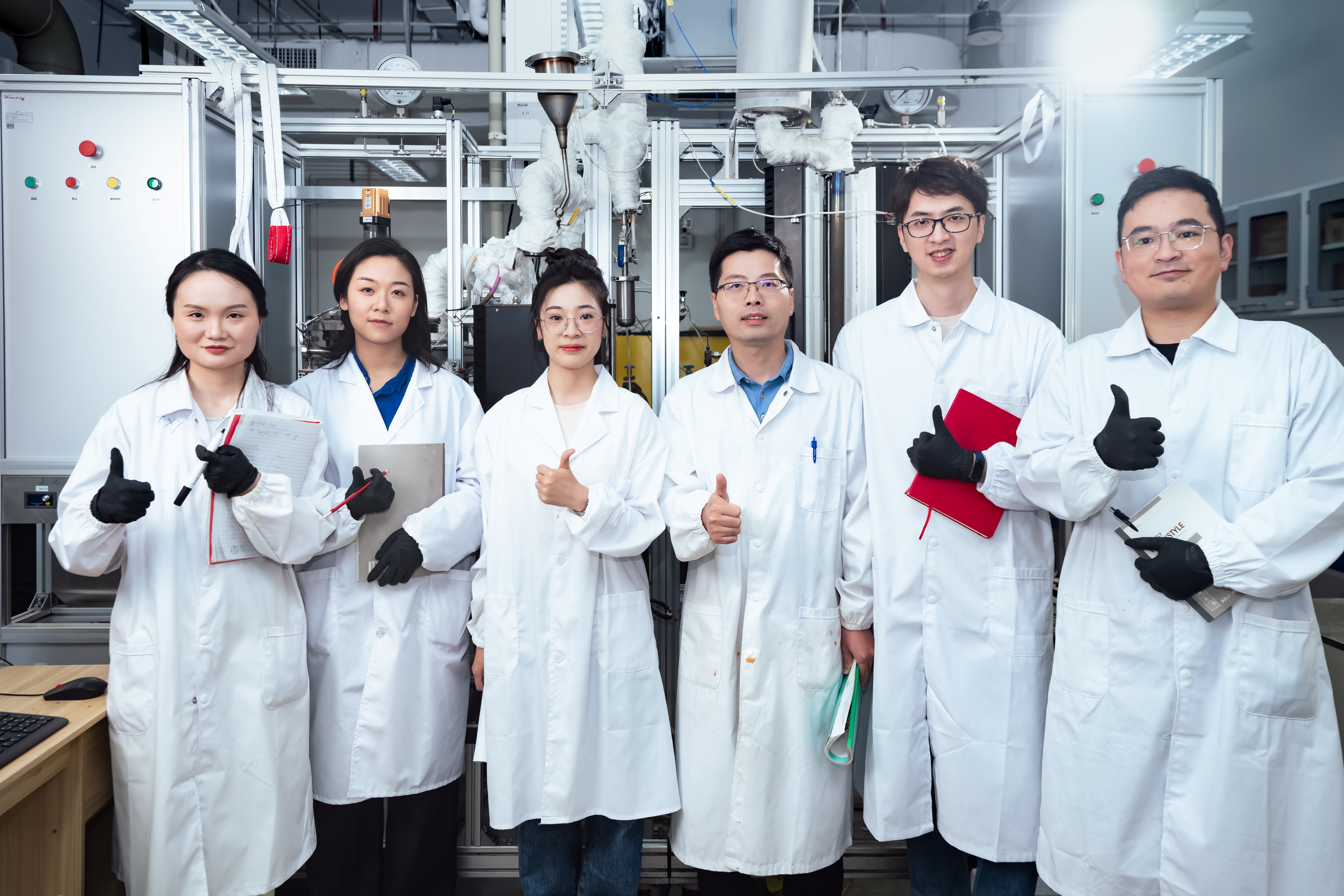
Xi Gao (right 3)
Innovative Practices
From bottleneck to blackboard – teaching follows real problems
Problem-driven, research-teaching integration. Breaking away from the traditional separation of teaching and research, the team established a mechanism that uses industry "choke point" problems as drivers for curriculum reform.
Research challenges were deconstructed into modular projects for core undergraduate and graduate courses. Graduate students, for instance, replaced instruction on commercial foreign software with hands-on tasks using the group's self-developed multiphase flow solver, SuperDEM. A three-tiered course chain—"theoretical modeling–algorithm implementation–industrial validation"—was also developed, with undergraduates focusing on foundational theory and basic operations, while graduate students engage deeply in technology development to sharpen their advanced problem-solving skills. Over the past three years, the team has transformed outcomes from three national and provincial-level research projects into teaching case studies, creating a deep integration of instruction and research.
Closing the loop – every side pulls its weight
Closed-loop, multi-interactive industry-academia-research integration. Leveraging institutional innovation as a linchpin, the team brought together universities, industries, and open-source communities to create a virtuous cycle of "research–application–teaching feedback." Outcomes from National Natural Science Foundation projects were integrated into the open-source MFiX platform, providing students with authentic research and practice environments. For example, students are encouraged to directly contribute to code development. Dai Jianjian, a 2022 Ph.D. candidate, led the optimization of the SuperDEM parallel solver and successfully integrated it into MFiX—a clear case of teaching outcomes translating directly into research output.
Through avenues like Guangdong Provincial Natural Science Foundation grants and direct collaboration with enterprises, students are engaged in industry-driven research, and a clear channel is in place to bring promising results toward commercialization.
Grades aside, real solutions speak louder
Competency-based, reform-oriented evaluation and incentives. Moving beyond the conventional "score- and publication-centric" assessment system, the team introduced a diversified incentive and evaluation framework that prioritizes practical engineering ability and innovative contributions.
In courses like Transport Phenomena, the team has introduced innovative assessment methods, allowing students to replace traditional exams with independently developed digital simulation projects and defense presentations. The focus is on evaluating exploratory process, algorithmic implementation, and problem-solving skills—a model widely appreciated by students for its emphasis on capability building. Undergraduates are also encouraged to join research teams early, with outstanding research achievements serving as strong credentials for graduate school applications. Over the past three years, more than ten undergraduates from the team have been admitted to top institutions such as Stanford University and TU Munich for master's or doctoral programs, forming a positive feedback loop of "research practice–capability enhancement–premium further education."

Reform Outcomes
Significant progress has been made in independent core algorithms and industrial applications, with the team receiving the 2023 ACS I&ECR Influential Researchers Award. Leveraging multiple proprietary patents, the team has developed non-precious metal nanocatalysts and advanced the bio-based production of high-value bioplastics and cosmetic raw materials, spinning off a startup, Yuanxi Biotech (Shantou) Co., Ltd., backed by RMB 2 million in municipal competitive funding.
Talent development has also seen remarkable improvement: undergraduates in the team have co-authored 13 SCI papers (nine as first authors), and all over ten have been admitted to top-100 global universities for further studies. Ph.D. students have also distinguished themselves in competitions and research funding, with multiple recipients of national-level awards and grant support.
This case exemplifies how national strategic imperatives can be translated into educational practice—driving teaching reform through research, and fostering talent development through industrial engagement. It offers a valuable reference for universities nationwide seeking to deepen industry-education collaboration in service of major national priorities. Looking ahead, GTIIT will keep tackling key industrial tech bottlenecks, promoting deeper industry-education integration to boost innovation and high-quality development.
Text/Photos: Xi Gao, GTIIT News & Public Affairs