PostTime:9/26/2025
Prof. Marcelo F. Ciappina, a 2025 World's Top 2% scientists list awardee from the Physics Program at the Guangdong Technion – Israel Institute of Technology (GTIIT), has achieved a breakthrough in attosecond science. In collaboration with research teams from ICFO, he has overturned the long-held belief that circularly polarized light cannot produce high harmonics, opening new avenues for applications in attosecond science. Their work was published in the prestigious journal Physical Review Letters.
This approach may provide powerful new tools to control and probe ultrafast electron dynamics in complex systems, thereby advancing the emerging field of attosecond quantum optics and highlights the leading role of GTIIT scholars in this field.
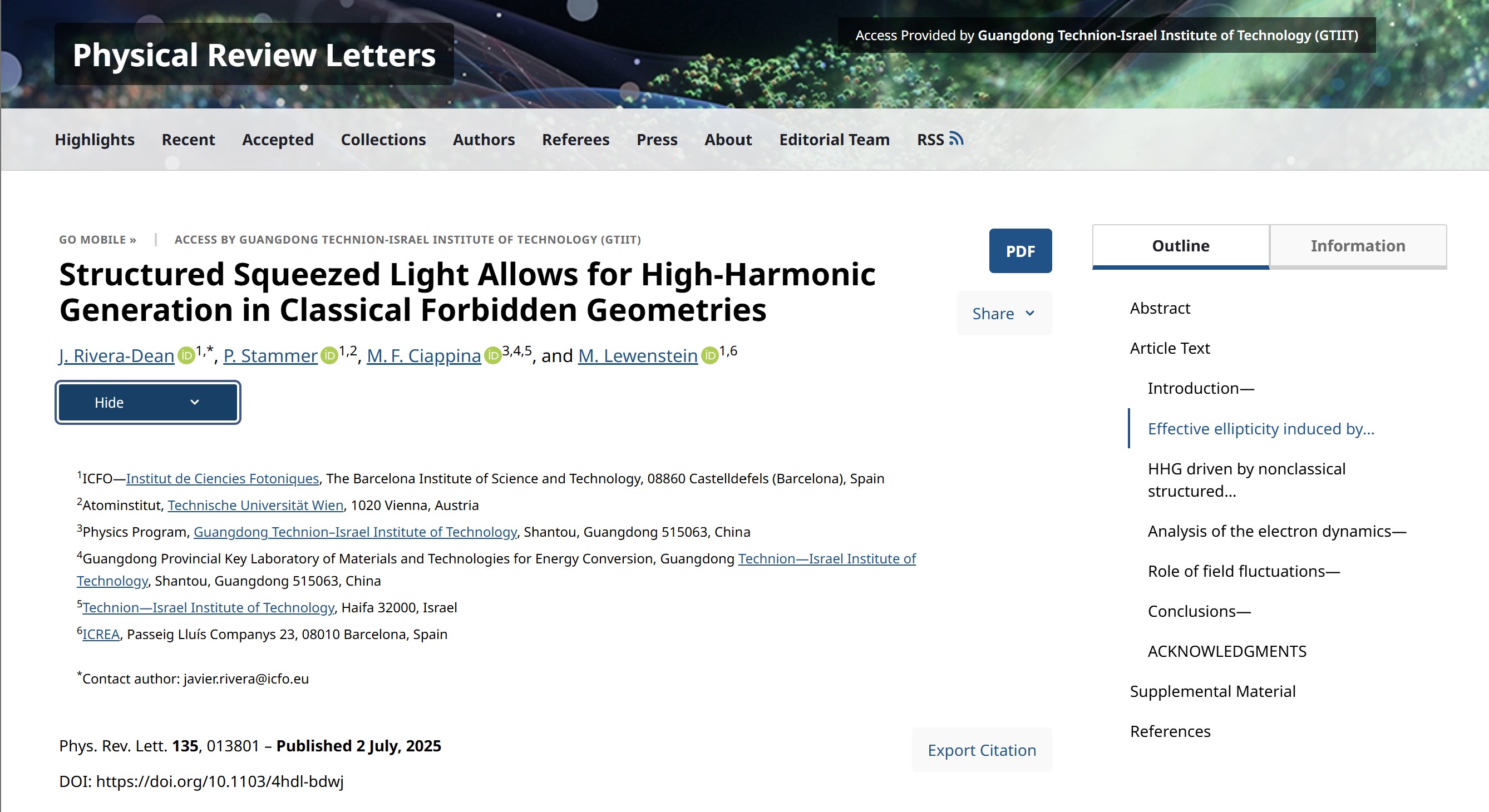
Journal Intro
Physical Review Letters (PRL) is the world’s premier physics letter journal and the American Physical Society’s flagship publication. Since 1958 it has contributed to APS’s mission to advance and diffuse the knowledge of physics by publishing seminal research by Nobel Prize–winning and other distinguished researchers in all fields of physics.
About the Paper
High harmonic generation (HHG) is a process where an intense laser interacts with a material to produce new light at much higher frequencies –the harmonics of the incoming laser’s frequency. This light only lasts a few attoseconds (10-18 seconds), making it an invaluable tool for observing electronic and nuclear motions within atoms and molecules, which typically occur on timescales too fast for longer light pulses to capture.
Despite extensive research aimed at understanding HHG, some open questions remain. For instance, it has been observed that when the incoming laser field is a coherent, classical light source, its polarization plays a crucial role in the outcome. In particular, when the light is circularly polarized—meaning its electric field rotates as it propagates— this typically suppresses the generation of high harmonics in atoms.
Prof. Dr. Marcelo Ciappina, in collaboration with ICFO researchers Dr. Javier Rivera-Dean and Philipp Stammer, led by Prof. Maciej Lewenstein, have overcome this limitation, overturning the long-standing belief that circularly polarized light cannot produce high harmonics. They have theoretically shown that high harmonics can indeed re-emerge by introducing strong enough fluctuations into the laser light.
Specifically, the team considered light with engineered quantum fluctuations that cannot be described by classical physics alone, caused by a quantum phenomenon known as squeezing. Not only did they show the emission of high harmonics, but they also found that their frequency and intensity depend sensitively on the quantum properties of light, particularly on the type of squeezing applied. Finally, they linked these observations to how the underlying behavior of electrons changes during the process.

(a): Strong, circularly polarized classical field interacting with an atom. Circular polarization prevents HHG. (b): Configuration investigated in our work, with one polarization component in a squeezed state. This enables HHG despite the circular-polarization conditions.
The researchers point out that non-classical light is not strictly required to enable high-harmonic generation (HHG) with circular polarization; rather, it is the presence of strong fluctuations—regardless of their origin—that plays a key role. However, this work introduces the compelling possibility of using structured quantum fluctuations in the driving field to actively tailor the HHG process. This opens new directions for investigating fundamental aspects of HHG and exploring its implications for advanced applications in attosecond science.
Online access to the article:
https://doi.org/10.1103/4hdl-bdwj

Prof. Marcelo Ciappina joined GTIIT in 2020 and was promoted to Full Professor and granted tenure in January 2025. DSc Dr Marcelo Ciappina took several years of Postdoctoral and Senior positions all around the world, including, amongst others, various Max Planck Institutes in Germany (MPI-K Heidelberg, MPQ Garching and MPI-PKS Dresden), the Institute of Photonic Sciences (ICFO) in Spain, the Extreme Light Infrastructure (ELI)-Beamlines in Czech Republic, the Institute of High Performance Computing (IHPC) (A* STAR, Singapore) and the Auburn University (USA).
DSc Dr Marcelo Ciappina is a top-class expert in theory and numerical simulations of nonlinear laser interactions with atoms, molecules, and complex systems. He regularly publishes in very prestigious scientific journals (Nature Physics, Nature Communications, Physical Review X, Physical Review Letters, Physical Review A). He is the author or co-author of around 220 papers in impacted journals listed in WoS, with more than 600 citations in 2024.